What should I work on next?

Showing posts with label A to Z. Show all posts

13 May 2012

Place, Show, and Also Ran, Part 3

Continuing the series...


"J" is also for... JAPAN

War Flag of Japanese Imperial Army

   At the end of the 19th century, Japan was making up for a couple of lost centuries worth of technological development, especially in the military. Seeing the strength of Western armies and navies, the Japanese determined to emulate the strong and improve on their technology by wedding the bushido mentality to the advanced weapons. What resulted was the foundation of a new Imperial Nippon. In VSF, they would certainly have been seeking a place in the solar system. For me, that place is on Mars, allying with some city-states that were distant from the British, French and Germans, then dominating them and making them puppets of the Shogunate of Mars. This is a project which I have considered, but for which very little has been purchased. I am looking strongly at Parroom Station's Japanese soldiers. BANZAI!!!!


"L" is also for...  LANDSHIP

   Steam-powered tanks, or landships, are quite common in Victorian Science Fiction. I think landships make the rest of the crazy VSF technology more believable, because they might have been possible. Certainly they would have been quite primitive things by even WWI standards, but possible? Just about, at least in some form.  So, with that small but believable stretch of reality, it makes the crazier things a bit more plausible. They are popular enough to merit their own rules (Land Ironclads, by Wessex Games) as well as inclusion in pretty much all the other rules available. There are many manufacturers of models for them as well. I am partial to Black Hat for the 15mm and Ironclad Miniatures for the 25mm, myself. Many excellent scratch builds are out there as well. Seems like everyone loves steam powered tanks! So why didn't I go with "L is for Landships" in the original list? Because I was already planning on discussing steam, and it fell under that category as well.

Trencher by Proxie Models. No longer available.

HMLS Prince Albert
[Modified Black Hat Miniatures Heavy Steamtank]


"P" is also for... PARROTMEN


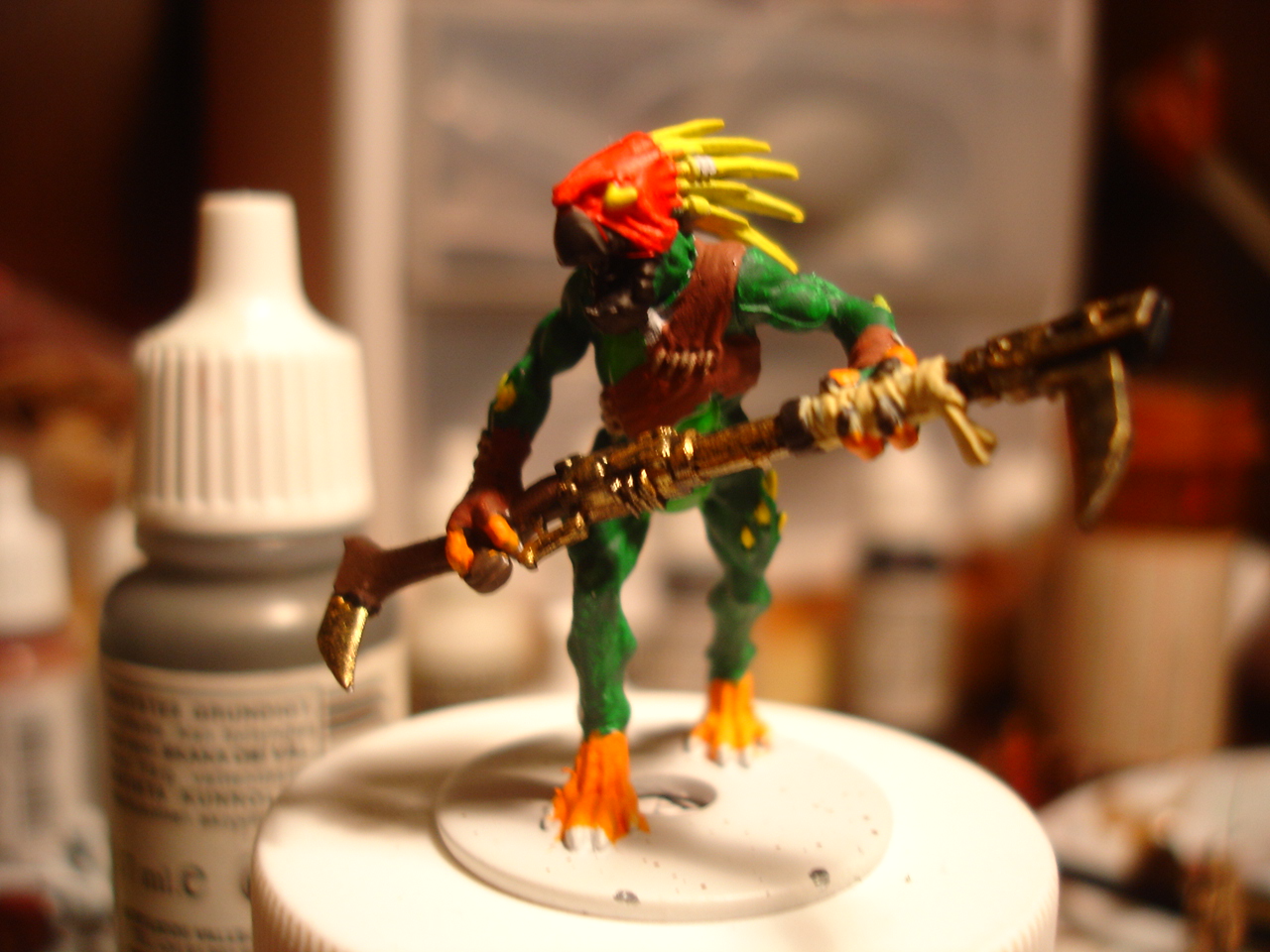
   Along with the ubiquitous lizardmen on Venus, the Cytherean Parrotmen are a very commonly used race in many VSF games. As far as I know, the idea originated on the Lead Adventure Forum, by a member known mysteriously as "DewbackUK".  Since then, I would imagine dozens of copycats (myself included) have jumped upon the parrotman bandwagon. For me, the project has stalled among the plethora of other things to do. But I did write a monograph on the Pappegaivolk. And I have figures for them, at least in 28mm. Like many others, I chose to use plastic GW Kroot, painted to resemble parrots, with their weapons modified a bit. Below is a work in progress photo. I chose Pellucidar over the parrotmen because my project has stalled. It might just be time to bite the bullet and send them off to be painted. Thirty or so of them, at $5 a piece... yikes! That's $150!!!!

Picture taken October, 2008 - talk about stalled!
"T" is also for...  TEXAS

   Like I wasn't going to work this one in somewhere? I'm a proud son of Texas, and my family arrived here from Alabama during the days when we were our own Republic (ca. 1837). I have a timeline of alternate history that keeps Texas a free and independent nation, through alliance with Britain in the 19th Century. There is also a VSF 'weird science' version of that timeline. The  only reason Tesla won out over Texas is because I can't imagine any VSF universe being complete without that mad genius. So, here's to the Lone Star Republic!

De Zavala Flag, the 'First National Flag of Texas'

Lone Star Flag, adopted in 1839


08 May 2012

Place, Show and Also Ran, Part 2

   Here we go with Part Two of the followup to the "A to Z" of Victorian Science Fiction. I want to thank Elderac for making some excellent suggestions in the comments on Part One. He was spot on with some obvious misses on my part. If you have something to add, please, leave comments! I check to make sure they aren't spam or something I wouldn't want my kids to read, but honest criticism I do not mind! It makes my projects better in the long run.

   Also, I found the 'original' list of ideas for the "A to Z," and want to go back and include them. And so, without further ado...

"A" is also for... AETHERGRAPH

   An aethergraph is, essentially, an incredibly long-ranged heliograph. Using a powerful Babbage Engine, an aethergraph transmitter, like the one pictured below, calculates the precise angle needed to send messages to one of the relay vessels in orbit around the planets and in chains across the Deep Aether. Once out of atmosphere, a signal can be sent millions of miles by the combination of massive mirror and precise control.
Aethergraph Transmitter, Victoria Landing, Mars
 
"A" is also for...  ATLANTIS

   Among the 'original' list of ideas that I failed to mention was Atlantis. I think everyone is familiar with the legendary sunken or lost continent of Atlantis, where the technology of the Ancients is still active. In my personal VSF universe, I don't use Atlantis as anything other than alegend and a spur to deep-ocean exploration, but in the When the Navy Walked Universe, it is very much alive and kicking!

Ruins of Atlantis? Ignore the skindiver...

"B" is also for...   BONGOLESIA

   An imagi-nation originally developed by Mike Murphy for his modern game AK-47 Republic, Bongolesia was once an African colony, which I have appropriated for my VSF Universe. In that timeline, it is the source of an amazing plant, the Bongolesian Oxygen Plant (Oxygenesis bongolesia) which produces an extraordinary amount of oxygen.


"B" is also for BABBAGE ENGINE


   This entry could just as easily have been dedicated to Charles Babbage, the genius inventor who designed it. Or it could have fallen under "D" is for Difference Engine - and it almost displaced dinosaurs there. The machine that Babbage built is, for all intents and purposes, a mechanical computer. In VSF, it often takes the place of computers in 'hard' science fiction. In my VSF Universe, they are very small and very powerful, and are fabricated and placed in all sorts of devices and applications. Babbage Engines run automatons, and calculate the angles for aethergraphs and aethergation.


"F" is also for... FREEMASONRY

The Square and Compass

   Freemasons are, by the late 1800s, a well-established secret society. Rumors of their conspiracies, wealth and power are already widespread. They can be used (I do not make use of them) as patrons, foes, whatever. For another good use of Freemasonry in colonial / Victorian Science Fiction gaming, watch The Man Who Would Be King, with Sean Connery and Michael Caine.

"H" is also for... HELIOGRAPH


   The heliograph is an ancient signalling device, updated and improved by the use of that American boffin Mr. Morse's simple code. It requires no wires, no power source, and is easily transported. All one needs to use it is a bit of sunlight and a clear line of sight. Telescopes or binocular scopes are useful for reading messages at greater distances.

   That's all for tonight, ladies and gentlemen.

06 May 2012

Place, Show and Also Ran, Part 1

   In the recently completed "A to Z" feature that I posted here, there were many times that more than one idea came to mind for a particular letter. However, being limited to choosing only one, I had to set aside these ideas for the time being. And many of them were good ideas. So, I have decided that I will do a series of "also rans", starting with this one. Each will be pretty short, and there will be multiple entries in each part of this series. I hope you enjoy.


"A" is also for... AUTOMATONS

Dr. Otto Maton's "Destroyer"-class Automaton
[Warbot Destroyer from Hydra Miniatures]

   Call them mechanickal men, or robots, or automatons, they are all essentially similar: mechanical creatures that do the bidding of their masters (usually). I have already gone into a bit of detail about my automaton forces in other posts, but I love the buggers. So, I chose to go with Aether for the original "A is for..." because I knew that automatons would show up later anyway.


"B" is also for... BARSOOM


      Barsoom, the Martian name for their own planet. The home of the incomparable Dejah Thoris, and the adopted home of the mighty warlord of Mars, John Carter, once of Virginia. Since Edgar Rice Burroughs wrote about the planet almost a century ago, it has captivated readers. The recent film by Disney showed it to us in a new light, and although the plot of the film was a weak amalgamation, the visual scope was great (except for the white apes. Oh well.). Barsoom also fell victim to the "I will cover this elsewhere" bug that got automatons - a theme that you may see several times throughout this series.


"G" is also for... GERMANY

A Prussian Guards banner
   I skipped several letters to get to "G," as I do not have anything written down right now for the letters in between "B" and "G" on the 'official' list of ideas for the "A to Z". Does that last sentence qualify as quotation marks abuse? back to topic: Imperial Germany is often used as the OPFOR when facing the British in a VSF setting. As others have pointed out, this is a bit anachronistic, as the real rivals during the reign of Her Majesty (God Bless Her) Queen Victoria were the Russians and the French. Germanophobia didn't begin to develop until the very end of the 19th century and the start of the 20th, when a series of invasion novels starring the Germans as the invaders of Britain were published. I thought that Germany (or Prussia, as some would have it) was sufficiently covered with "K is for Kaiser".

   Enough for now - I will be back in a day or two with more, starting with "H is also for..."

02 May 2012

A Brief Pause for Breath

   Ladies and gentleman, I shall be taking a brief respite from blogging for a few days to finish up some book reviews for my professor. When I return, I'll be doing a few "Place, Show, and Also Ran" posts, covering some of the alternates that I did not choose for the A to Z. I'll also throw in a few pictures of some of the minis I have painted in the last few weeks - nothing too earthshaking, but glad to get a few things done.

01 May 2012

"Z" is for...

ZEPPELIN

   Zeppelin (n.): a rigid cylindrical airship consisting of a covered frame containing multiple gas cells, and with a suspended compartment for passengers and engines.


   There was, of course, no way not to mention the Zeppelin and other forms of flying ships when discussing Victorian Science Fiction. You may as well leave out Her Majesty (God Bless Her!) as flying vessels! The idea of flying ships was written about by Victorian writers (Jules Verne published Master of the World in 1904, just a few years after Edward took the throne).

   Graf Ferdinand von Zeppelin started designing the style of airship which would bear his name in the 1870s after seeing airships used by the Union in the American Civil War and the French during the short-lived Franco-Prussian War. The first real zeppelin (LZ-1) was built in 1899. Zeppelins were used as bombers in World War I and as commercial vehicles after the war until the Hindenberg crash in 1937 ended their popularity. (Oh, the humanity!) In my VSF universe, I have Zeppelin retiring from the military at a younger age due to injuries sustained, and getting into the development of airships sooner as a result. Zeppelins fitted with more powerful engines and using a wondrous lifting gas (hydrium, an idea copied from Kenneth Opel's Airborn novels) are commonplace in the late 19th century of my little universe.

   Besides zeppelins, which are just really cool, the VSF enthusiast has a variety of airships to choose from. Most use some for of lighter-than-air technology, which is often non-gaseous in nature, thus eliminating the need for huge gas bags to provide lift. Liftwood, cavorite, and unobtainite are some examples of this. The problem with massive gas cells is that they are, well, massive. Big, relatively slow targets, which can't be significantly armoured due to weight considerations. Using liftwood, etc., eliminates that liability and makes armoured airships much more practical.

A small 6-man gunboat
[Laughing Ferret, 25mm conversion]

    Some airships are small gunboats, intended to swiftly enforce the will of the Great Powers which build them. The British Naval Air Service's ubiquitous Aphid-class is a prime example of this type. Others are massive behemoths of armourplate and turreted 14" naval guns, bristling with batteries of quick-firing light guns, and cruising slowly through the air, dominating the sky. The Class IV dreadnought is one of these types of airship.

HMS Aphid
<> 
Dreadnought Class IV Airship

   I know of several good rules sets that exist for VSF airship fleet battles, in alphabetical order:
  • Aeronef, by Wessex Games
  • Dystopian Wars, by Spartan Games
  • GASLIGHT Compendium, by Palmer and Surdu
  • Sky Galleons of Mars, by GDW (and Heliograph)
  • When Dreadnoughts Ruled the Skies (not commercially published that I know of)
  • When the Navy Walked, by The Arm Chair General (I helped write these rules).
   I have played in games using all of the above rules except for Dystopian Wars, and enjoyed them all. Except for When Dreadnoughts Ruled the Skies, all of them also have associated ground forces rules suitable for playing air-to-ground engagements and mixed actions. If I have inadvertently left any systems you are aware of out of the above list, please let me know and I will be happy to add it!

Naval Zeppelin

30 April 2012

"Y" is for...

YANKEE

   When I was a kid, I thought that 'yankee' was only half of a word, and being called one was good enough to start a fight in the schoolyard down here in Texas. However...

   One of the common aspects of Victorian Science Fiction is an alternate history, not just an alternate technology, and one of the most popular variants of alternate histopry is one in which the American Civil War continued far longer than it did in our history, or in which the Confederate States somehow managed to prevail in Mister Lincoln's War. Which, if you have studied that conflict, is really unlikely.


   In my VSF Universe, the War Between the States lasted longer than in the real history, but the South still lost. Just like in the real world, the war sparked a lot of incredible development in technology. Add that to the possibilities of VSF, and you get some interesting developments. The GASLIGHT game has some material set in an alternate Civil War (Victoria Hawkes, etc.), and there is the RPG Deadlands, where the war is still going on a decade or so later. Deadlands is an overlooked horror/VSF crossover, I think largely because of its setting in the American West. But when you can go to Mars, the West is not really that far a frontier any longer!

29 April 2012

"X" is for...

XENOZOOLOGY

   Xenozoology is the study of animal lifeforms not of terrestrial origin. It encompasses many species across the solar system, where native life has been located on three other bodies so far (Luna, Mars, and Venus). It also includes the sapient humanoids of those planets, in all their variety.

   Like all science fiction, Victorian science fiction revels in a plethora of "strange new worlds... new life and new civilizations," to paraphrase Captain Kirk. (Speaking of which, I simply must have an aethership captain named that - Picard is far too French - oh, maybe have him captain the French vessel? Yes!) And so we have a lot of different ideas for inhabitants of these worlds.

Barsoom Burroughs's vision of Mars had a dying planet with four truly sentient races, the Red, Green, Black, and White Martians. I do not count the plantmen, since they seemed more like animals than people, even if humanoid. Other creatures mentioned include the thoats, calots, and the great white apes.

Space: 1889 Chadwick developed a different set of Martians, the civilized Canal, nomadic Hill/Steppe, and barbaric High Martians. High Martians have wings and lifting glands which allow them to fly. In addition, a variety of animal life, especially for Mars, is described. He also places insectoid Selenites on Luna, and primitive Lizardmen on Venus.

Wells H.G. Wells postulated an invasion of Earth by Martians which were definitely alien. Beaked, furred, and tentacled, they used far superior technology and dastardly devices like poison gas to try and subdue Britain and the rest of the world.

   In my own universe, I combine Space:1889 and Barsoom for red Martians, with both civilised and barbaric flying martians as well. Venus is teeming with life, and a variety of different sorts of lizardmen, sentient mobile plants, and parrotmen. Dinosaurs wander the Venusian jungles, and a variety of dangerous creatures prowl the Martian deserts.

28 April 2012

"W" is for...

WEIRD SCIENCE

   The key aspect of Victorian Science Fiction is the SCIENCE! Anachronistic science, violating the laws of physics, incredible advances and imaginary substances all play their part in the development of the fantastic technologies that appear everywhere in VSF. You want examples?

Liftwood. From Space: 1889, this miraculous substance is a wood that grows only on Mars, and has anti-gravitational properties. Rare and expensive, it is still favored for the construction of sky galleons. Sadly, it doesn't work on Venus, deteriorating at an incredible rate.

Unobtainite. My own creation. Run an electric current through this naturally occuring element (which forms blue crystals) and it repels gravity. More current, more repulsion. Great for making flying vehicles, and less fragile than liftwood.

Cavorite. From H.G. Wells, cavorite is a metal that pushes against gravity unless shielded from it. Used by Professor Cavor to ascend to the moon.

Radium engines. Verne used radium engines (essentially, atomic reactors) to power the Nautilus. Heck, the Nautilus itself was an anachronism of wonderfully weird science. I like the Disney version.

Nautilus

Babbage's Difference Engines. While this idea really existed, it was never fully developed. In essence, a mechanical computer. In VSF, not only did Babbage perfect it, it has been made ever smaller and more powerful, until it fits in the body of a man-sized (or smaller!) automaton.


Flying Ships, forts, etc.  Either airships (lighter than air) or liftwood, or unobtainite, or cavorite... it doesn't matter, we like ships that fly. And not just small balloons, but big armored warships. Robur thought he could conquer the world from his. A very popular game (Dystopian Wars) is currently in production around the concept that flying dreadnoughts are cool. Because they are.


Automatons. Mechanical servitors, often steam powered, but also clockwork based. These can be man-sized, or smaller, or even much larger. Mad geniuses build them to conquer the world, huge companies market them to the public, and to industry.

Maton's Halfjacks, a Work in Progress photo

Walkers. Walking vehicles are another favorite of the genre. From one man conveyances to massive four-legged (or more!) armoured behemoths, the walker is just fun. Powered by steam, of course.


The engine for HMLS Gargantua, by Colonel O'Truth
I love the flywheel.

Landships. The last item of weird science I will mention here is the ubiquitous landship. Early tanks would appear only a few decades after the real Victorian era, and armoured land trains using steam traction engines had been used already against the Boers. So we just bump that up a bit, add in the improvements in turreted weapons from the 1930s, power it all by steam, and cover it in riveted armour. Can't forget the rivets! Almost everyone in VSF gaming has at least one of thses bad boys. I have several, in different scales.
 

27 April 2012

"V" is for...

VENUS


   Really, what else could it be? I mean, since I have already mentioned Her Majesty, Queen Victoria (God Bless Her!)? Following Mars and the Earth, Venus is undoubtedly the third favorite planet for Victorian Science Fiction games and stories. There is something about the mystery of what is on the surface of the Veiled Planet, the Planet of Mystery, the Jungle Planet: VENUS!

   Modern science tells us that nothing we recognize as life could survive on the surface of Venus, such is the density and composition of the atmosphere. Bah! Frank Chadwick and Edgar Rice Burroughs may not have the science on their side, but they do have the advantage of being mroe interesting. No, my friends, the surface of Venus is covered with oceans, marshes and jungles. A few highland areas thrust upward from the trees and wetlands, more comfortable for humans to live than the incredibly hot and humid lowlands.

   The fertile soil of the Venusian jungles has given rise to many strange creatures. Dinosaurs roam the rainforest. Lizardmen, anthropomorphic reptiles and amphibians live in small villages throughout the lands. In the trees, a race of parrotfolk make their nest villages. Animated plants move through the underbrush. German zeppelins cruise the skies over Venusstaadt, and British, Italian, Japanese, and Texican colonies dot the highlands. The riotous biology of the planet has even brought respected scientists like Doctor Vardu to Venus to study the life forms.

One of the Varieties of Parrotmen
[GW Kroot, converted, from Lead Adventure Forum]
   The Parrotfolk of Venus and the Lizardfolk do not get along well. Some tribes of Parrotmen are allied with European powers. This provides the Europeans with scouts, and gives the birdmen firearms. These weapons help the parrotfolk defend their nest villages high in the trees from the ravages of the far more numerous lizardfolk and dinosaurs.

Venusian Manticore Rose, a deadly plant
[QRF, personal collection]
    Much of the flora of Venus is as deadly and dangerous as the fauna. The manticore rose, shown above, actually fires barbed and envenomed thorns from the bulbous head at the top of its stalk. Any creature coming within a few yards is the target of a deadly barrage.

One of many Lizardmen found on Venus
[Khurasan Miniatures, 15mm]
   As previously described in the "A to Z", there are numerous sorts of lizardmen. You can find more out about them here.

Plantmen, Vardu's Sprouts
[25mm Vardu, Hydra Miniatures]
   The final denizens of the Cytherean jungles are the plantmen. No one knows much about these strange creatures. They are the object of much study by the eminent xenobiologist Doctor Vardu. Unknown to pretty much anyone else, Vardu is actually creating plantmen and animal-human hybrids as part of his studies. He has gone quite mad, you see.

   Venus: the Veiled Planet. Planet of Mystery. Also the subject of novels by Edgar Rice Burroughs (though less popular than the Barsoomian series). A great place for adventure, exploration and danger! Plus, lots of neat terrain to put out on the table.

26 April 2012

"U" is for...

UNIFORMS

   The 19th Century was the last hurrah for really beautiful uniforms, and everyone had them. So here they are, real, imaginary, and awesome. Let the eye candy begin!

French Foreign Legion
   Seeing these fellows makes me realize I need to do some re-painting on my old FFL 15mms. Somehow I missed the madder red trousers.


   Uniformology books are excellent. Loads of research and good images. Another thing I need to be buying more of. German Schutztruppe - very cool colonial types.


Texican

    These are my Texicans (originally 15mm Span-Am War Americans). We see here Lieutenant Harold Godwinson, in the butternut uniform of the Texican Marines adopted recently. The regulation campaign cover is clearly visible.

British Patrol jacket, and redcoats
   More from my personal collection, this time 25mm Empress Miniatures (which I absolutely love). The officer is wearing the dark blue patrol jacket fashionable in the latter 19th Century. The regular infantry are still wearing the traditional red jacket in all my VSF units. Why? Because I love it, and its my game, so I play how I want to. Besides, they look awesome.

German Aetherbattalion Sergeant
    One last of my own collection: a paint-converted GW Mordian Imperial Guardsman. This is the uniform of the totally fictitious Aetherbattalions (loosely based on Seebattalion).

8th Canadian Hussars
   A real Commonwealth unit. Love the sabretache and the tall boots. Obviously based on British cavalry uniforms. Check the busby on him, too.  

Russians


25 April 2012

"T" is for...

TESLA

   Nikola Tesla, a man who was both a certifiable genius and just plain certifiable.

   Born in Smiljan, Croatia, Tesla was educated at Graz and Prague, worked for the Continental Edison Company in Paris, and emigrated to the United States in 1884. There he worked briefly for Thomas Edison until the poetic Tesla and the pragmatic Edison fell out. Tesla then went on to sell his patents for a series of alternating current devices to the Westinghouse Electric Company, making Tesla a relatively wealthy man able to set himself up in his own laboratory.  

    So far so good; sounds like the biography of many a successful Victorian electrical engineer. But Tesla was a first-class ego case with aristocratic pretensions. He was a tremendous showman who excelled at giving spectacular demonstrations of what electricity could do. He was an intuitive genius who could visualize all sorts of revolutionary new devices even though he didn't fully understand the principles behind them. He had a remarkable memory, coupled with an intense dislike of writing things down, so that much of his work has come down to us as a mystery. He was a man with no money sense who was able to persuade many an investor into pouring money into his schemes. He was also a visionary who, as time went on and his professional fortunes ebbed, became prone to wilder and wilder assertions about what marvels he would perform and how he could single-handedly change the world.
   Tesla's real achievements combined with his flamboyant dreams made him a regular source for reporters looking for sensational copy and a lightning rod for nutcases who were convinced that he was really an emissary from the planet Venus.
Nikola Tesla (1856 – 1943)

   The thing that makes Tesla such a compelling, yet sad case is that he was genuinely brilliant and had carved himself a real place in history with his accomplishments.  His contributions to the field of electrical engineering are on a scale to rival that of Edison and Steinmetz and we enjoy the fruits of his labours every time we flick on a light switch.  However, his lonely work habits, refusal to write things down, and flat-out eccentricities have made him one of those figures that historians cross the street to avoid.

AC Induction Motor


   Tesla's first great invention was the AC induction motor. An electric motor works by flipping the field of an electromagnet, causing the attraction/repulsion of the magnets to spin the armature around.  Tesla was the first inventor to come up with a practical way of using AC power to achieve the same reversal of polarity; only this time it's done with clever wiring. Unlike DC, where the electrical current always flows in one direction, AC current flows in both directions. By wiring some of the magnetic sections of the motor one way and then their neighbour sections in reverse, the polarity would reverse automatically with the current.

    The trick was how to supply current to the armature itself without burning out the contacts with the high voltages that AC power required. Tesla's answer was to use induction. In Tesla's motor, the induction field set up by the AC current feeds power to the armature without any direct wiring needed.

AC Power


   But the really neat thing about electrical motors is that if you get one working you also have a perfectly good electrical generator in one of technology's rare twofers.  An electric motor works by taking electricity in and turning it into motion.  But if you take a motor and spin it, out comes electricity.  All this means that when Tesla perfected his motor, he was well on his way toward building a new generation of AC dynamos that form the basis of our modern electrical grid. When Westinghouse bought up Tesla's patents, it sparked (get it?) a commercial war between Westinghouse and Thomas Edison, who was a great backer of DC.  There followed years of bitter propaganda battles - Edison invented the electric chair to demonstrate the dangers of AC power - but in the end the AC system won out.

The Tesla Coil


    Curiously, despite his achievements, Tesla never had a very good theoretical grasp of what electricity actually is.  He tended to ignore developments in physics.  In fact, he greeted Einstein's theory of relativity with downright hostility.  For Tesla, electricity wasn't a thing of electrons and energy states, but of fluids, vibrations, and harmonics in a system which he seemed to understand, but which made his explanations the thing of which headaches are made.

    Whatever his theory, Tesla still managed to get results.  He was fascinated with high frequency electricity, but mechanical generators could only go so fast before they started to fly apart. So, he developed devices that could provide higher and higher frequencies without moving parts. The most famous of these was the Tesla coil; this high-voltage transformer is familiar to anyone who has seen an old Frankenstein movie where they were used to generate the electrical arcs that are apparently necessary if you're going to be a respected and card-carrying member of the Society of Mad Scientists. They also produce an electrical field that lights fluorescent tubes and similar devices at a distance, a spectacular parlour trick that led Tesla down more than one rabbit hole.

Radio


   Tesla's interest in high frequency electricity had other benefits.  A number of his circuits were basic to radio technology.  Because he didn't understand how electromagnetic radiation worked, Tesla thought that sending messages through the air required transmitting huge amounts of energy, so he never produced a working system, but his patents did predate those of Marconi by several years and Tesla was awarded precedence by US Supreme Court in 1943.

Remote Control

   Another of Tesla's certified firsts was in the field of teleautomation, or remote control to me and you.  In 1898 Tesla demonstrated a peculiar little tub-shaped boat which he was able to control at a distance with a small box.  That may not seem like much today, but this first ever exhibition of radio remote control caused a sensation at the time.  Tesla was able to start and stop his little boat, steer it, and make its lights flash.  With his more advanced model, he could even make is submerge on command.  As an added fillip, Tesla's boats were designed with interlocking circuits that prevented hijacking of the boat by more powerful transmitters. The circuitry he used is similar to that used by cell phones to prevent signals from crossing over today.

Broadcast Power


   In the 1890s, Tesla was playing about with sending high-voltage currents through evacuated glass tubes and he discovered that a tube containing rarefied gas could conduct current rather well.  But for Tesla, this wasn't good enough. He leapt from a simple laboratory observation to declaring that he'd discovered the secret of transmitting electricity to all the world without wires. He reasoned that since he could send electricity through a tube of rarefied gas, and that the Earth's ionosphere was also composed of rarefied gas, then it would be a simple matter to send electricity up into the outer reaches of the atmosphere and charge the entire planet like a gigantic Leyden jar that could be tapped on demand.  With such a system, dynamos, batteries, and the like would all be a thing of the past. Anything from a pocket torch to an aeronef to a battleship would have literally unlimited power at its disposal regardless of large it was, how long it ran, or where it was located. Sadly, it just didn't work.

Superimposed photo of Tesla in his laboratory.

VSF


   Many of Tesla's claims in the real world were never realized: death rays, earthquake machines, etc. But in the realms of Victorian Science Fiction, well, he's practically a galvanic god. Tesla's inventions led to handheld death rays, aeronefs, broadcast remotes, automatons, and all manner of wonders. In my VSF universe, he is currently working with the United States government to develop military applications of his technology, including wireless telegraphy!

[Editor's note: A great deal of the above was taken from Tales of Future Past. The author there did such a great job of balancing Tesla's genius with his lunacy, I just couldn't resist.]

24 April 2012

"S" is for...

STEAM

   Yes, Steam! The power behind all of our Modern Science and Conveniences! From the simple coal-fired pumping engines of our mines and factories, to the mighty handwavium-fueled turbines of HMAS Duke of York! Without steam, our Progress would grind to a halt. Humble heated water, yet Modern Life is inconceivable without it.

Simplified Schematic of Triple Expansion Reciprocating Steam Engine

   At its most basic, the steam engine uses the expanding properties of heated water to gaseous form to push a piston. A series of controlling valves directs the flow of the steam, and increases efficeincy in the use of the working fluid in the system. This sort of steam engine is most common in ships and landships, where weight is not a premium concern, but power and reliability are.

 
HMS Turbinia, the first turbine warship
   More recent developments include the use of steam to spin a set of turbine blades, which are then connected by complicated gearing to provide motive power for large vessels. The concept was first proven by HMS Turbinia. It has since been incorporated in vessels of all sizes, including the huge aetherbattleship, HMAS Duke of York, and small airships such as the Aphid-class and Dauntless and Intrepid.

   With the advent of handwavium and steam turbines, steam engines have become increasingly tiny and intricate, yet surprisingly efficient. These miniscule wonders power the automatons which are quite the wonder of our Modern Age. They can even be attached to galvanic generators to provide energy to Unobtainite, with all of the gravity-neutralizing effects that mineral produces. This is how Professor Maton, for instance, gives flight to his hoverton servitors.

  And so today, we celebrate Steam!

23 April 2012

"R" is for...

RUSSIA


  In the playing of the Great Game, Russia was historically the Big Bad Bear from the British point of view. Being a massive Eurasian empire, and poised oh-so-near to precious India, it was Russia that Britain most wanted to stop from expanding. As a result, the Crimean War was fought. Russian and British interests collided in Afghanistan and Turkey as well.

Something the British never wanted to see in the Khyber Pass!
[Strelets' Cover Art for Winter Uniform Russians]

   Russophobia was even the catalyst for a serious naval building program in the late nineteenth and early twentieth centuries, to counter the two next-largest fleets (French and Russian, who were allies). Now imagine this conflict, or imperial rivalry if you prefer, to the rest of the inner solar system in Victorian Science Fiction. The new Space: 1889 novels have done so, with a mad Russian conducting infernal experiments for the Tsar inside a lunar crater.

   If you are looking for a good counter to British colonialism, but are reluctant to use the more common Prussian/German enemy model, give the Russians a look. There are a LOT of them, and history is really on your side here.

22 April 2012

"Q" is for...

QUEEN VICTORIA
(God Bless Her!)


   Her Majesty Victoria, by Grace of God, of the United Kingdom of Great Britain and Ireland Queen, Defender of the Faith, Empress of India. She literally defined the era which was named for her. The longest reigning monarch of Britain, she oversaw the expansion of Empire across the globe, and into the solar system.

21 April 2012

"P" is for...

PELLUCIDAR

   The world is hollow, you say? An absurd idea! But at one time many believed this to be the case. Some still do. Edmund Halley is most famous for the comet named after him. He also thought the earth was hollow, a theory he proposed in 1692. The biggest push for the idea, though, came from John Cleves Symmes, who published a pamphlet in 1818 describing how access to the interior could be achieved by traveling through openings at both the north and south poles. Symmes even petitioned the U.S. Congress to fund an expedition to "Symmes Hole!" Sadly, the sticks-in-the-mud in Congress weren't interested.

   Pellucidar was first discovered by David Innes and Abner Perry, who built an "iron mole" to reach mineral wealth deep in the Earth. Their journey ended abruptly when they emerged into the inner world of Pellucidar. The adventures of Innes and Perry were chronicled, starting in 1915, in Edgar Rice Burrough's series of novels about it, beginning with To the Earth's Core.


   Pellucidar is a world without time, without night, and without mercy. Dinosaurs and prehistoric mammals of all sorts roam the interior of our Earth. Humanity is a few scattered tribes of primitive men and women, who are under the control of the beastly Mahar and their savage Sagoth enforcers.

   But Pellucidar is not the only variant of the Hollow Earth theory in popular fiction or gaming. DC Comics once had Skartaris, a lost world accessible only by the polar regions, in which Travis Morgan became Warlord. TSR had a Hollow World RPG. Back to Victorian Science Fiction, the idea is in use by When the Navy Walks, in the world of Earthin.

   Earthin is a strange place inhabited by fantastic beasts and humans of many different cultures. These cultures evolved apart from their surface cousins, and are therefore noticeably altered from them. I can't go into a great deal of detail about this mysterious place... yet.

20 April 2012

"O" is for...

OTTO MATON


   Herr Doktor Professor Otto Maton, a Belgian mechanickal genius, is the designer of many of the wondrous mechanickal devices that inhabit my Victorian Science Fiction universe. Some of these inventions are in use by a variety of empires and nations. A partial listing of his impressive works includes:
  • Whirlifliegertornister: the whirling flying backpack used by fliegerjaeger
  • Voltaic pistol: a sidearm which discharges a ray of intense heat and light
  • Maton's Aetherpropeller: smallest known aetherpropeller
  • Sentinel Walker: A British light armoured steam walker.
  • Anti-'Nef Rocket: A set of barrage rockets specifically calibrated to shoot down flying vessels
  • Steamhorse: a mechanickal horse, powered by steam, of course
  • Sono-troller: a hypersonic projector which controls automata at a distance
  • Black Smoke Projector: a fiendish artillery device
  • Magneto-gun: using electromagnets, it fires a high velocity steel projectile
   Automatons are, not surprisingly, his specialty. He has built hundreds of them, to serve him in all capacities. They operate under programs written by Maton or his assitants and then inserted into their mechanickal brains. His work with mechanickal beings has left him quite unhinged, however, and Maton is currently in hiding on Mars. His goal is to set himself up as Otto the First, Solarian Emperor.

Brass Soldaten [Clockwork Soldiers, 25mm, Parroom Station]

Hovertons
[Hoverbots, 25mm, Hydra Miniaturs]

Limpet Spiders
[Steam Spiders, 25mm, Wyrd Miniatures]

Destroyer
[Destroyer, 25mm (and HUGE), Hydra Miniatures]

Half-Jacks
[25mm, Privateer Press]

Toolbots
[25mm, Reaper]
   Maton is served by several nefarious characters of biological origin as well. His primary lieutenants are a Celestial woman named Yuko Oni and a French madamoiselle named Luci D'Amonds, both of whom he has trained extensively in the programming and control of automata. He has another assistant, the mysterious figure known only as Fez. No one is sure where Fez comes from. Many human mercenaries also serve the cause of Maton, in hopes of gaining a position of importance under his Empire. To hide their identities, and protect themselve from the poisonous gasses that Maton is fond of using in his diabloical schemes, they wear elaborate breathing masks.

The Mysterious "Fez"

Masked Minions
[25mm, Parroom Station]
   Maton imagines himself to be a serious threat to the Solar System. To date, he has been more of a nuisance in the badlands of Mars than anything else, although many nations regret the loss of his particular brand of genius. Germany would be very happy to capture him and force him to develop new weapons for them, as would the Tsar.

   From a gaming perspective, one of the nice things about automatons is that they are really pretty scale-neutral. I use the same figures for 15mm and 25mm. In 15mm, they are just bigger and scarier. I also make mine a bit... unpredictable. While they know no fear, they can malfunction. Rules for using Automatons in GASLIGHT can be found in Vol. 1, Issue 1 of The Aethergraph.
   As a side note, every photo in this post comes from my personal minis collection.