At long last, I have published the new issue of The Aethergraph. You can find a link to it on the left hand column, right at the top there, or simply click here. I would like to thank my contributors, and the gentlemen that offered me submissions that I didn't have room for this time around. I'm hopeful that, especially with more submissions, I can produce another issue this spring - perhaps in April or May.
I hope you enjoy it. Please let me know what you think, and if you are interested in helping to produce The Aethergraph, email me at aethergraph@gmail.com.
Showing posts with label Reginald's. Show all posts
Showing posts with label Reginald's. Show all posts
14 February 2014


14 May 2012
Reginald's Regiments of Renown, Issue #12
Luftschiffetruppen:
The Kaiser's Aether Marines
History
The Kaiser's General Staff realized there was a need for troops in the Empire's off-world colonies even before those colonies were established. A temporary levy of line troops was sent with the original colonists to Venusstadt, but they proved inadequate for a variety of reasons: equipment failures, heat prostration, and poor familiarity with jungle maneuvers all led to less than satisfactory results when dealing with threats from local natives and wildlife. A new solution was needed, and a young officer named Oskar von Goster had it.
Von Goster took advantage of the Kaiser's new holdings in equatorial Africa to train a new kind of soldier. These troops were to be prepared for service aboard airships and in colonial Venus, and were given the unique designation of Luftschiffetruppen, or "Airship Soldiers." Equatorial Africa provided the Germans with a long period of acclimatization to tropical conditions similar to those that would be encountered on Venus. It also provided the opportunity to learn the ins and outs of jungle fighting, so different from the tactics of open field warfare taught to the line infantry. The emphasis on small unit tactics and low level leadership initiative was quite different from the iron discipline of the Prussian line regiments and the esprit de corps of the hussars and uhlans. Service is entirely voluntary, the troops coming from any line regiment. Because of the extended training, Luftschiffetruppen will serve an additional two years with the colours before transferring to reserve status.
One year of jungle and small units training is followed by four additional months of shipboard training with two small training vessels built especially for the task - another first in military history. The K.As Midgard and K.As Asgard were launched in early 1872, and are used to train the Luftschiffetruppen in airship landing assault, aerial assault, and aerial boarding techniques. The training vessels are also used to train the Aetherbattallions and the sailors of the Kaiserliche Aetherflotte. They are based in German Southeast Africa, at Wilhelmshafen.
The first battalion of Luftschiffetruppen was ready for service in August of 1872, and embarked upon K.As Loki for transport to Venusstadt. A second battalion was entering the second phase of training at that time, and a third was just beginning the first phase. The training schedule called for three battalions to be at various stages of training at one time until a full regiment was built. An additional regiment was authorized by the General Staff, to be created at a reduced pace over the following five years. There are currently two regiments of Luftschiffetruppen serving in various capacities for the Kaiser's Imperial ambitions. The First Regiment is stationed permanently in Venusstadt Kolonie, the most important of the German off-world colonies. Second Regiment has a battalion stationed on Mars, and a second one serving as marines aboard airships on both Mars and Earth. The third battalion provides security troops at the Imperial German airship fields all across Earth. In addition, there is a training battalion that feeds new men into both the service regiments.
The Luftshiffetruppen have fought in every major off-world battle since their deployment. Innumerable small conflicts with Venusian natives and Martians have been settled. Possibly the most famous of their battles was the Second Defense of Venusstadt. A large force of Venusian lizardmen - the largest recorded host of the vicious brutes - attacked the walls of Venusstadt at dawn on 21 July 1878. Luftschiffetruppen at the downport responded by stampeding a herd of domesticated dinosaurs through the foe, then opening fire with their Mausers. Additional support from a Gatling-armed walker and some special weapons of the Aetherbattalion contingent were also instrumental in halting the scaly warriors' advance against civilization on Venus.

[Editor's Note: It's been a long time since I last posted a Reginald's Regiments. This one has been sitting for a while. I decided it needed to be put out there, finally.]
Von Goster took advantage of the Kaiser's new holdings in equatorial Africa to train a new kind of soldier. These troops were to be prepared for service aboard airships and in colonial Venus, and were given the unique designation of Luftschiffetruppen, or "Airship Soldiers." Equatorial Africa provided the Germans with a long period of acclimatization to tropical conditions similar to those that would be encountered on Venus. It also provided the opportunity to learn the ins and outs of jungle fighting, so different from the tactics of open field warfare taught to the line infantry. The emphasis on small unit tactics and low level leadership initiative was quite different from the iron discipline of the Prussian line regiments and the esprit de corps of the hussars and uhlans. Service is entirely voluntary, the troops coming from any line regiment. Because of the extended training, Luftschiffetruppen will serve an additional two years with the colours before transferring to reserve status.
One year of jungle and small units training is followed by four additional months of shipboard training with two small training vessels built especially for the task - another first in military history. The K.As Midgard and K.As Asgard were launched in early 1872, and are used to train the Luftschiffetruppen in airship landing assault, aerial assault, and aerial boarding techniques. The training vessels are also used to train the Aetherbattallions and the sailors of the Kaiserliche Aetherflotte. They are based in German Southeast Africa, at Wilhelmshafen.
The first battalion of Luftschiffetruppen was ready for service in August of 1872, and embarked upon K.As Loki for transport to Venusstadt. A second battalion was entering the second phase of training at that time, and a third was just beginning the first phase. The training schedule called for three battalions to be at various stages of training at one time until a full regiment was built. An additional regiment was authorized by the General Staff, to be created at a reduced pace over the following five years. There are currently two regiments of Luftschiffetruppen serving in various capacities for the Kaiser's Imperial ambitions. The First Regiment is stationed permanently in Venusstadt Kolonie, the most important of the German off-world colonies. Second Regiment has a battalion stationed on Mars, and a second one serving as marines aboard airships on both Mars and Earth. The third battalion provides security troops at the Imperial German airship fields all across Earth. In addition, there is a training battalion that feeds new men into both the service regiments.
Service History
The Luftshiffetruppen have fought in every major off-world battle since their deployment. Innumerable small conflicts with Venusian natives and Martians have been settled. Possibly the most famous of their battles was the Second Defense of Venusstadt. A large force of Venusian lizardmen - the largest recorded host of the vicious brutes - attacked the walls of Venusstadt at dawn on 21 July 1878. Luftschiffetruppen at the downport responded by stampeding a herd of domesticated dinosaurs through the foe, then opening fire with their Mausers. Additional support from a Gatling-armed walker and some special weapons of the Aetherbattalion contingent were also instrumental in halting the scaly warriors' advance against civilization on Venus.

[Editor's Note: It's been a long time since I last posted a Reginald's Regiments. This one has been sitting for a while. I decided it needed to be put out there, finally.]
05 July 2011
Reginald's Regiments of Renown, Issue #11
1st Velocipede Dragoon Regiment
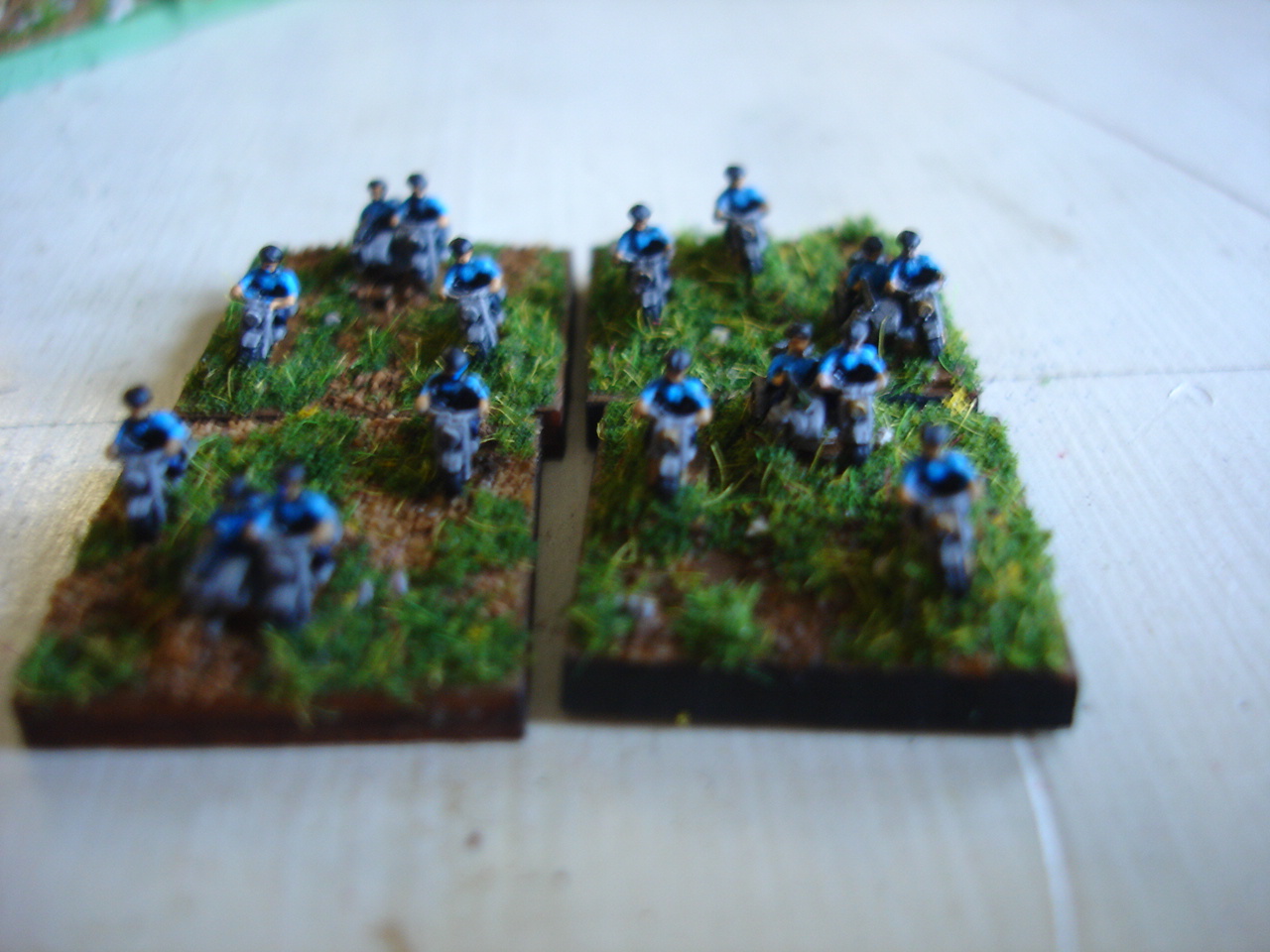
The invention of the steam-driven bicycle, more accurately described as the velocipede, led quickly to a military development. Faster than horses, and able to carry more equipment than a man on foot, the velocipede and its flankcar provide mobility and firepower to the Kaiser's forces. Already trained in mobility tactics and prepared to fight dismounted, the dragoons were a natural fit for the velocipede regiments.
The uniform of the Velocipede Dragoon is very similar to that of the standard dragoons. The light blue jacket is worn, along with dark trousers and riding boots. Black infantry helmet is standard, but omits the spike of the traditional pickelhaube for safety reasons.
Each dragoon is armed with a carbine, but one out of three of the velocipedes is provided with a flank car and a second rider. This flankcar carries a pintle-mounted machinegun that can also be detached and fitted to a tripod. This massively increases the firepower of the Velocipede Dragoons.
The regiment itself is so new that it has yet to see combat. However, the combination of firepower and mobility ensure that the Velocipede Dragoons will certainly have a major impact on the future of warfare.
22 February 2011
Reginald's Regiments of Renown, Issue #10
Legion Extraterrestriale
1er Demi-brigade
History
The Legion Etrangèr or Foreign Legion, was created by Louis Philippe, the "King of the French", on 10 March 1831. The direct reason was that foreigners were forbidden to serve in the French Army after the 1830 July Revolution, so the Legion was created to allow the government a way around this restriction. The purpose of the Legion was to remove disruptive elements from society and put them to use fighting the enemies of France. Recruits included failed revolutionaries from the rest of Europe, soldiers from the disbanded foreign regiments, and troublemakers in general, both foreign and French. Algeria was designated as the Legion's home.
In late 1831, the first Legionnaires landed in Algeria, the country that would be the Legion's homeland for 130 years and shape its character. The Legion was primarily used, as part of the Armée d'Afrique, to protect and expand the French colonial empire during the 19th century, but it also fought in almost all French wars including the Franco-Prussian War.
The Legion Extraterrestriale was formed in 1871 from elements of the Foreign Legion for service in the off-world colonies on Mars and Venus. The Legion originally consisted of two demi-brigades of four battalions each, with one DBLE (Demi-brigade Legion Extraterrestriale) assigned to each planet, and a recruiting and training cohort on Earth. In 1875, a third demi-brigade was authorized for service as security in the highport of the three French aetherports and as special aether-equipped boarding parties. 1er DBLE is stationed on Mars, headquartered with the rest of the Armee d'Mars in Nouveau Paris, the capital of the French colony.
Just as the original Legion accepted anyone, regardless of their nationality, religion, color or, shall we say, less-than-lawful past, so does the new Legion Extraterrestriale. Men who are desperate to escape their past may easily be forgotten, taken off-world to march or die in the service of La Belle France.
Combat History
The 1er DBLE has been involved in several border clashes with the colony's neighbors, including the British Crown Colony and German Marskolonie. However, the main antagonist for the French are the desert dwelling natives which raid the colony from time to time. In this, the Legion Extraterrestriale has much in common with the Foreign Legion.
A company of 1er DBLE was involved in the First Battle of Ghola, along with a steam walker for support. The captain of that detachment won the day by personally cutting down the Martian commander of a larger contingent of the famed Emerald Legion and retrieving the priceless antiquities found in the ancient temple at Ghola.
Other portions of the demi-brigade have been involved in patrolling the frontiers and manning small outposts in remote areas along the edges of the Martian desert. One trouble the legionnaires often must contend with in these isolated posts is le cafard, the 'bug.' The intense psychological strain of such isolation for weeks or months causes some men to lose their minds, commiting acts of desperate violence. Legion units in extended garrison always lose more men to le cafard than to combat. The textbook solution for le cafard is a rifle, and plenty of opportunity to use it.
Uniform


The standard uniform of a legionnaire is, in most respects, identical to that of the Foreign Legion, consisting primarily of a white shirt and white fatigue trousers. A blue capote is worn over the shirt, and a light blue sash as well. Cloth or leather gaiters are worn over low black boots.
The most iconic piece of the Legion uniform is the white kepi. The kepi is a type of cap with a flat circular top and short visor and a neckcloth. The history of the white kepi can be traced back to Africa where it was first worn by French soldiers in their Africa posting to protect them from the hot desert sun. It was adopted by the Legion Etrangèr while they served in North Africa, and passed on to the Legion Extraterrestriale.
Other than regimental distinctions, the primary difference between the two Legions' uniforms is the badge on the kepi. The Foreign Legion wears a grenade badge with five plumes of flame. The Legion Extraterrestriale's cap badge is a three-plumed grenade on a five-pointed star.
Officers wear the same uniform as enlisted men with two major distinctions: a red-topped kepi and gold epaulettes. Also, they are equipped with sword and pistol rather than the enlisted man's rifle and bayonet.
Officers wear the same uniform as enlisted men with two major distinctions: a red-topped kepi and gold epaulettes. Also, they are equipped with sword and pistol rather than the enlisted man's rifle and bayonet.
Armament
Legionnaire infantry carry the French service rifle, 120 rounds, and a bayonet. Until last year, that rifle was the Fusil Gras Modèle 1874 M80, an 11mm caliber bolt-action rifle. In 1886, the Lebel Model 1886 replaced the Gras. The Lebel is an 8mm rifle with an 8-round tubular magazine and bolt-action, firing a new smokeless powder round. Officers carry the MAS 1873 revolver and the Model 1882 Infantry sword, a straight bladed weapon.
Legion artillery support is provided by the De Bange 90 mm cannon (Mle 1877). At this time, in large part to the mitralleuse debacle in the last war with Prussia, the French Army has not procured a machinegun for service, although it is considering adoption of the Hotchkiss model.
It is rumored that the Imperial Ordinance Commission is secretly developing weapons similar to the British Tesla rifle, the reciprocating carbine, and the portable mortar. At this time, no reliable information about these developments exists.
02 April 2010
Reginald's Regiments of Renown, Issue #9
Manchester (63rd) Regiment
History
The 63rd Regiment was formed in 1758 from the 2nd Battalion, 8th (The King's) Regiment of Foot during the Seven Years War against France. The regiment has been a single battalion regiment for most of its lifetime, barring a short period during the Napoleonic Wars when a second battalion was created. The 63rd has served Her Majesty (God Bless Her!) in many theaters of operations, including Afghanistan, New Zealand, and the Martian Crown Colony.
In 1881, as a result of army reforms, the 63rd (West Suffolk) Regiment was amalgamated with the 96th Regiment of Foot into the Manchester Regiment. As with all the regiments, many officers and other ranks still refer to the regiment as the 63rd (it having numeric precedence over the 96th, you see).
The Manchester Regiment was posted to the Martian Crown Colony in 1880.
Combat History
The 63rd has taken part in the Seven Years War, the American Rebellion, the Napoleonic Wars, and the Crimean War. Some of the battles in which the 63rd fought include Bunker Hill (1775), Brandywine (1776), Monmouth (1778), Guadaloupe (1809), Martinique (1810), Inkerman (1854) and the Siege of Sevastopol (1854-55). More recently, the Regiment took part in the Second Afghan War in 1878. Their services were invaluable in defending the passes of the Northwest Frontier from Afghan irregulars.
Since arriving at the Crown Colony, the 63rd has performed the usual tasks of garrison and patrol duty that occupy a colonial force in peacetime. There have been small clashes with natives, Fenians, and smugglers, but no major battles. The largest skirmish involved the attempt by Imperial German forces to assist a smuggler delivering a clandestine cargo to the German advisors in Galfor. Company A of the 63rd's First Battalion, along with a squad of the R&D Platoon, successfully defended the site of the crashed smuggler's airship. As usual, the entire incident was hushed up and smoothed over through the timely intervention of the Foreign Office's skilled diplomats.

Colour Sergeant Graves, Company A, 1st Battalion, 63rd (Manchester) Foot
The Manchester Regiment is outfitted in the manner typical of modern British Line Infantry. The basic field uniform consists of white sun helmet, scarlet tunic, grey shirt, white braces, dark blue trousers with scarlet outside seam, brown leather leggings and low black leather boots. Facings (collar, epaulettes and cuffs) are white for this English regiment. NCO insignia is worn on the right sleeve, as shown above in the photostat of Colour Sergeant Graves.

Lieutenant Gorse, Company A, First Battalion, 63rd (Manchester) Foot, wearing patrol jacket
Equipment for enlisted men consists of white leather 1879 pattern gear. Enlisted men and NCOs are armed with the Martini Henry breechloading rifle. Sergeants carry a sword bayonet, Other Ranks a triangular spike style. Officers wear a Sam Browne belt and shoulder strap, and are typically armed with revolver and saber. Again, individual officers may make adjustments to their equipment as funds, personal tastes, and regimental command sees fit to allow. After all, the officers do pay for their uniforms out of their own pockets.
[Editor's Notes: These are my new Empress Miniatures Zulu British. They are available in the US from Age of Glory in Maryland. I really like these figures. I have more, but it will probably be a bit before I get another batch painted. I am concentrating on finishing up the Automaton army in April.]
[Editor's Notes: These are my new Empress Miniatures Zulu British. They are available in the US from Age of Glory in Maryland. I really like these figures. I have more, but it will probably be a bit before I get another batch painted. I am concentrating on finishing up the Automaton army in April.]
13 March 2010
Reginald's Regiments of Renown, Issue #8
2nd Gonzales Foot
Army of the Republic of Texas
History
The Republic of Texas declared independence from Mexico in 1836. An army of volunteers had already been formed, and successfully gained independence for the Republic on the field of battle at the San Jacinto River, on April 21st of that same year.
It was soon realized that the persistent threat from Mexico would not allow Texas to remain independent without keeping a small professional standing army to deter Mexican aggression. Thus, the Army of the Republic of Texas was created. Since those beginnings fifty years ago, the Army has grown along with the Republic. Each regiment is named for the region in which it was raised, thus the Second Gonzales Foot is the second regiment of infantry raised from the Gonzales region.
It was soon realized that the persistent threat from Mexico would not allow Texas to remain independent without keeping a small professional standing army to deter Mexican aggression. Thus, the Army of the Republic of Texas was created. Since those beginnings fifty years ago, the Army has grown along with the Republic. Each regiment is named for the region in which it was raised, thus the Second Gonzales Foot is the second regiment of infantry raised from the Gonzales region.
Combat History
The Second Gonzales has seen combat against hostile Indian tribes in the Republic, and along the borders of the Republic with both the United States and Mexico. The Second was instrumental in turning back an attempted invasion of the Republic from Mexico by the disavowed General Ugarte in the summer of 1851. At the battle of Alto Montes Foothills, the Second held the center of the line against Ugarte's infantry while Texas Ranger cavalry attacked the Mexican flanks.
A company of the First Battalion, Second Gonzales Foot, is posted to the Texican Consulate in the Martian Crown Colony. As such, they took part in the defense of the Consulate against attack by rioting Martians in the unpleasant events of last fall. After the riots subsided, the Texican infantry assisted British forces in patrolling around the city of Victoria's Landing, searching for pockets of dissident activity.

Lieutenant Harald Godwinson, 2nd Gonzales Foot
Uniform
The Second Gonzales wears the standard uniform of the Republic of Texas Army. In the field, and on regular duty, butternut tunic and trousers made of heavy cotton fabric are supplemented by brown leather boots and equipment. A brown felt campaign cover is standard issue headgear. The Texican forces are currently armed with their licensed copy of the Martini Henry breech-loading rifle. Officers carry a Colt revolver and sword instead. Rank distinctions are on the sleeve for NCOs and on the collar for officers. Branch of service insignia is worn on the campaign cover, and a colored cord indicates officer, NCO, or enlisted status.
Dress uniform includes a dark blue tunic, with slate grey trousers. Infantry trousers have a wide black stripe down the leg seam on the outside. Dress headgear is the Belgic shako, in black. Officers have a gold cord on the shako; other ranks have black. Belts and boots are in black leather. Epaulettes on the tunic carry unit designations. Specific rank insignia is on the high collar of the tunic. The dress uniform is rarely worn, and many enlisted men only don it twice in their careers: at the ceremony for the end of initial training and when mustering out. On-duty guards at government facilities wear the dress uniform, as do consulate and embassy officers, and officers assigned to the General Staff Office.
07 January 2010
Reginald's Regiments of Renown, Issue #7
Saint Sebastian's Regiment
Zoauves of the Holy See
History
The Papal States in central Italy have held secular power over the region as well as their religious authority for hundreds of years. In the last century, increasing tensions and a series of invasions of the Italian Peninsula led the Pope to call for aid from the Catholic faithful around the world. Thousands of young men have answered the Holy Father's call to arms, and enlisted in the Earthly Host of Saint Michael. The strenghtening of the States was one cause of the formation of the Confederation of Italian Nations in 1768.
Of all these young men, probably the most famous regiment is the Saint Sebastian Regiment. Drawn out of their home antions to fight in foreign lands, these romantics naturally favored the dashing uniform of the Zouave. The Saint Sebastian Regiment is made entirely of non-Italian troops, excepting some officers and the regimental chaplain corps.
When the Vatican began sending missionaries to Mars, many were martyred by Martian natives. The Earthly Host dispatched two companies of Zouaves to protect the missionaries. With their lives protected, the missionary work bore fruit, and the ruler of a minor city-state in a remote area converted to the Church of Rome, even going so far as to rename his city Nova Roma. Additional priests, monks and nuns arrived quickly to spread the Faith, and additional soldiers came withthem to help defend the small city from its larger neighbors and attacks by native religion supporters against the Church and the faithful. Eventually, an entire regiment of Zouaves would be assembled on Mars.
Combat History
The Saint Sebastian Regiment of Zouaves are trained as elite light infantry. However, due to the restrictions of their current mission, they have been used primarily as garrison forces at a variety of mission stations in the region of Nova Roma. In this capacity, they have been involved in a number of small skirmishes, but no actions involving more than a single company. Rather, most of these skirmishes stayed at a platoon command level.
The Defense of St. Agnes Parish was fought between a platoon of Zouaves and a force of approximately forty natives. Disciplined rifle fire, superior marksmanship and rapid reaction to the developing crisis saved not only most of the platoon's lives, but also prevented the destruction of the church. Unfortunately, the rectory was destroyed by fire as the vandalizing natives withdrew in confusion. Father Ted Nichols survived the assault unscathed.
The Martian Heresy Crusade began in September of last year. Since then, members of the Holy Order of the Inquisition have been instrumental in suppressing the native cults which claim that "God was a Martian."

Uniforms
Zouaves are well known for thier brightly colored, exotic attire. The Saint Sebastian Zouaves are no different in this regards. Their tunics are purple, with yellow and white trim. Trousers are grey, spats (worn over the lower trouser leg) are white, and boots are black. Leather equipment is usually black. Headgear consists of a kepi, in wool matching the shade of a Zouave's tunic or frock coat.
French gunmakers designed a new weapon for the Zouaves: the 11mm long rifle, more comonly referred to as the Hammer of God, the rifle's massive weight, extreme length and punishing recoil made general issue of the weapon impossible. Officially, the Anti-Material Rifle is used only by superior marksmen in the Zouaves.
01 January 2010
Reginald's Regiments of Renown, Issue #6
Ätherbattalion Regiments
History
AR.1 was despatched to Neu Berlin in the Venusstadt Kolonie in 1872 after six months in German East Africa. AR.2 spent eight months in the Arabian desert as guests of the Ottoman Turks in preparation for their embarkation to Mars. Both regiments were carried to their respective off-planet destinations aboard the immense KAS Thor, an etherbattleship.
Combat History
AR.1 has been involved in numerous small actions in protection of the Venusstadt Kolonie. Their primary function is the protection of the Governor's Palace and the aetherport just west of Neu Berlin. Most of these actions have been against the native lizardfolk of Venus, who seem very hostile to human colonization. There have been a few incidents involving conflict against the parrotmen natives as well, though generally the German relations with these strange creatures have been amicable. Finally, some rumors of attacks against Neu Berlin by strange, plantlike creatures have been made, but are dismissed by British Intelligence as koo-fruit brandy-fueled hallucinations.
Officially, AR.2 has not seen combat action. In truth, it is believed that the regiment participated in the recent rioting in Galfor. Indeed, the uniform of the regiment is supposed to have been the cause of those riots! It is known that AR.2 is training Galforrian troops in modern military techniques, and Her Majesty's Government is afraid that German influence in the Empire may lead to additional troubles from that quarter.

Corporal Bauer demonstrates the powerful Granatwerfer, designed by the KFG
 Herr Colonel Otto von Sickle, directing his troops of AR.1 during maneuvers on Venus
 Feldwebel Hans Glick waving his squad of Soldaten forward in the Venusian jungles
Uniform
Soldaten
The uniform for regular soldaten (privates) and corporals (Gefreiter) of both AR.1 and AR.2 is generally identical. It consists of a white high-collared cotton jacket over a white cotton shirt, with black collar, cuffs, epaulettes and piping. Trousers are feldgrau with a black seam along the outside leg. Boots and leather carrying equipment are brown. Peaked hats, with white crowns, black edges and brown leather brim are worn, and a brass regimental device is attached to the front. Regimental distinction is displayed on the epaulettes: red trim for AR.1, and white for AR.2.
Feldwebels (sergeants)
The uniform distinctions for sergeants in the Ätherbattalions includes silver trim on collar, cuff, trouser seam and epaulettes. Additionally, all buttons, buckles and cap badges are silver in place of the regular soldier's brass.Officers
Officers wear uniforms similar to the regular troops, with various distincitons based on rank. All officers have gold trim on epaulettes, collars, cuffs and trouser seams. Buttons, buckles and cap badges are gold rather than silver or brass as for lower ranks. Field grade officers have additional braid on their cuffs and jackets. Officers also wear aguilettes on the left shoulder. The aguilette color code is as follows:
- Both cords red - Leutnant
- One red, one red and black - Oberleutnant
- Both red and black - Hauptmann
- One red and black, one silver - Major
- One red and black, one gold - Colonel
Weapons
The Ätherbattalion regiments are supplied with advanced weapons by the KFG (Imperial Secret Weapons Institute). Privates and NCOs are typically armed with an Elektrogewehr, which spits bolts of intense galvanic energy. Some may be armed instead with a variety of heavier weapons such as Granatwerfer, Flammewerfer, Heibestrahlgewehr or Raketenwerfer. Officers are armed with Voltaischepistollen and Kraftschwert (powered swords). Some (usually senior) officers opt for traditional weapons like pistols and cavalry sabers.
28 December 2009
Reginald's Regiments of Renown, Issue #5
The Emerald Legion
 The Legion begins to deploy on the outskirts of the village of Ghola
History
The Emperors of Galfor have long utilised mixed infantry forces in their armies. Armed with a combination of long pikes and muskets, these soldiers resemble in some ways the tercios of Earth's history. The famed Emerald Legion, one of the most disciplined and best drilled native infantry regiments in the System, is one such tercio.
The Emerald Legion was originally raised by the Empire approximately 900 years ago, when Galfor was a mere city-state along the Great Wolof Canal. Thanks to the technological stagnation caused by the so-called Fall of the Ancients, their arms and training methods have not changed in all that time. Their training regimen is especially brutal, and reportedly less than half of the recruits are accepted as Legionnaires. A full quarter of all recruits die during the initial training.
Combat History
As you might imagine, a regiment that has existed for nearly a millenium has been in combat more times than an article of this scope may record. However, a brief history of recent events seems appropriate.
The Emerald Legion fought at both the First and Seccond Battles of Ghola, where they were overwhelmed by British technological might and unstoppable military resolve. They did give an excellent accounting of themselves, and were the very devil in close quarters combat. The Legion took advantage of the cover granted by their pavises until the last moments, when they flung themselves into the clash of cold steel against our brave Tommies and a few blue-coated legionnaires of the French Legion Extraterrestriale. Sadly for them, their numbers had been so reduced by fire from the ASA (Armored Steam Automaton), Mk II, that they were swiftly pushed back. Once their captain had been slain, the rest of the Legion withdrew hastily from the field.
The Legion has also been involved in several of the attacks on British and French outposts that have taken place lately. One such attack rapidly reduced the platoons of British and sepoy infantry protecting a convoy of unobtainite, and made off with the valuable stuff. The Emperor sold it to his German advisors, no doubt!

Several Legionnaires, positioned for battle.
Uniform
The standard Legionnaire of the Emerald Legion wears a long green tunic and laced ghurr leather hobnailed sandals. Rank is indicated by yellow bands on the hem of the tunic for officers.
In battle, Legionnaires wear armor. A breastplate protects the torso, with a mail kilt hanging below to protect the soldier's upper thighs. Greaves and a metal helmet - quite similar to the ancient Roman helmet - complete the protective gear. The helmet is crested, with a plain green for regular Legionnaires and a yellow stripe for officers. While useless against modern weapons at even moderate ranges, the armor does protect against long range shots and in the general melee of bayonet versus pike.
Legionnaires are armed with either a long pike or a rifled muzzle-loading musket. NCOs may have a modern breechloading carbine as well. Officers are armed with swords. The Legion's commander also carries a baton carved from the ivory fangs of the deadly h'lee'rael sand tiger(http://vbir.blogspot.com/2009/02/tiger.html). Finally, each unit is equipped with a number of large wooden pavises, which they use as cover on the open plains of the Martian deserts. These thick wooden shields are virtually immobile during combat, but can provide a decided advantage when fighting against primitive Martian firearms. The pavise is universally painted a bright emerald green, with the Martian character for the letter "G" in yellow.
[Editor's Note: The miniatures pictured here are from Black Hat's excellent 18mm Martian Empires range. In the US, you can get them from Scale Creep (www.scalecreep.com).]
26 December 2009
Reginald's Regiments of Renown, Issue #4
The Warband of Slee-stak
(Ess’this R’sska Slee-stak)
History
(Ess’this R’sska Slee-stak)
History
Being both of alien origin and hostile intent, little is known of the origins of the great Gater warlord known as Slee-stak. Slee-stak and his barbaric horde of lizardmen first encountered humans when the German aethership KäF Das Vaterland sent down zeppelin-based scouting parties. One surveying party, which located the eventual site of the settlement of Neu Berlin in the Venusstadt Kolonie was attacked by the warband. Slee-stak’s attack was stalled by German firepower, although three German Ätherbattalion troops were slain in the fighting. The German surveyors retreated to the safety of their zeppelin launch and returned the following day with additional troops. There was no sign of the lizardmen, and the only remains of the three slain troopers were their well-gnawed bones.
Since that day, Slee-stak has become quite fond of man-flesh. He and the Kss’rssa Ess’thiss (Viper Warband) he leads raid all along the southern border of Venusstadt. Mounted on his huge carnosaur, Slee-stak runs down fleeing colonists and impales them on his massive bronze lance. The governor of the Venusstadt Kolonie has placed a 10,000 mark bounty on Slee-stak’s red scaled head.

One element of the warband, some gex archers of the primary green morph

Slee-stak himself, mounted on his favorite carnosaur.
(Photostat found in camera at site of attack)
Organization
Slee-stak’s warband seems to be divided into sub-groups based on color morphology. Most of his followers are of the smaller lizardman type, called gex by humans. They are typically armed with either stone-tipped javelins or bows. A few of the bolder gex carry bronze weapons instead. In total, there are approximately forty gex following Slee-stak.
One group of about ten of the larger ‘gater’ type lizardmen also follows Slee-stak. They share his black and red color morphology, and are likely from the same hatching as their mighty warlord. Like most lizardmen, these gaters are armed primarily with primitive stone and wooden weapons, although they have also obtained some metal weapons.
Slee-stak himself is rarely seen on foot, preferring to stand out form the crowd of lesser warriors by riding the back of a vicious carnosaur.
23 December 2009
Reginald's Regiments of Renown, Issue #3
Royal Artillery
Research and Development Platoon
History
The origin of the Research and Development Platoon of the Royal Artillery is shrouded in secrecy. It is thought that Her Majesty's Government began a secret program of technological development in the years immediately after the Russian War. Evidence for this lies in the budgetary increases to the Royal Artillery passed by Parliament at the urging of the Prime Minister and the Horse Guards. The precise nature of the expenditures is listed merely as 'Confidential.'
It is certain that the public first became aware of the Research and Development Platoon (RDP) in the spring of 1866. Every Londoner remembers that spring, of course: the rampaging dinosaurs through Hyde Park would be impossible for anyone to forget! Cnventional rifles failed to bring down the largest beasts, and conventional artillery was considered too indiscriminate to use in the midst of London's better residences. Quite right, too, as the home of none other than Sir Reginald himself is in that district! I digress. Conventional weapons being unsuitable, Her Majesty personally demanded the newly developed weapons be employed against the great monsters. One squad of electrorifle armed soldiers laid the beast low, and Lieutenant Hiram Goswalding removed the head with his chainsword. Suitably mounted by the taxidermist's arts, the head now rests as a trophy above the RDP's wardroom fireplace.
Combat History
Other than the Hyde Park Dinosaur Incident, the RDP has primarily seen service in the off-world colonies. It took part in the Ikora Pacification, the Defense of Victoria Landing, and the Second Galfor War. There have also been numerous skirmishes with natives of both Mars and Venus. The most famous of these minor actions has been the Retreat to Aphrodite on Venus, where the First Squad of the RDP acted as rearguard against a horde of the native lizardfolk. Sergeant John Cooper distinguished himself by killing the horde's warchief as the brute tried to ride down a wounded Tommy. A single shot from his Caloric Ray Emitter burst the warchief's chest in a gory spectacle of Imperial bravery and technology's superiority over native cunning and ferocity.

Lieutenant Goswalding and two privates of the RDP, atop "Bessie", a draft bronto on Venus

Sergeant Edward Tisintrite, RA RDP, aboard HMAS Bee
Uniform
The RDP wears a uniform similar to the standard British infantryman of a Royal regiment: red woolen tunic with blue facings, white fringe on the epaulettes, and dark blue trousers with red seams. The cut of the tunic is different from the standard British issue, being double breasted and buttoning on the right hand side. Black boots (officers wear brown) and white equipment and sun helmet, with brass fittings to all. Officers wear brown leather equipment and a gold aguilette on the left shoulder is common.
Weaponry varies, but the 'standard' longarm for the RDP is the Johnson Patent Electrorifle. Officers carry a Grenville Voltaic Pistol and have their preference of Benson Vibrating Sword or the 1871 Jamison Pattern Chainsword. Other weapons include the Caloric Ray Emitter, patented by Prof. K. Blooie, the Bening Pattern Flamegun, and the Man Portable Hale's Rocket Launcher.
22 December 2009
Reginald's Regiments of Renown, Issue #2
Das Erste Regiment der Fliegerjaegerren
(First Flying Hunter Regiment)
History
The First Fliegerjaegerren Regiment was dreamt up by the notorious mad scientist Otto Maton when he worked for the Kaiserlich Forschungsanstalt fur Geheimewaffen (Imperial Research Institute for Secret Weapons) in the late 60s. Maton developed the fliegertornister device in nine months. General Muller approved testing the device in 1871, and a call for volunteers was made. No one volunteered. In the great Junker tradition, General Muller then volun'told' the first soldier he saw - Herr Leutnant Schickelgruber of the Quartermaster's Corps.
Faced with a choice of possible death by ingenious device, or certain death by firing squad for disobeying an order, Schickelgruber hesitantly strapped on the fliegertornister (flying pack). Doctor Maton wound up the clockwork springs that powered the fiendish whirling blades. Moments later, Leutnant Schickelgruber discovered exactly how difficult piloting one of these contraptions could be, by slamming repeatedly into the side of the zeppelin hangar adjacent to the test site. He was awarded the Blue Max (posthumously).
After some fine tuning, Maton tested the device himself in front of a group of elite Prussian Jaegers in 1873. Convinced the device could be managed better by real soldiers (as compared to thumbless idiots of the Quartermaster's Corps!), the Jaegers demanded instruction in the arts of personal flight. More demonstrations of their ability in front of the Chancellor convinced the Army to fund and field an entire regiment of flying jaegers.
Combat History
Due to multiple delays in finishing equipment procurement and training, the First Fliegerjaeger Regiment was not ready for duty before the end of the Franco-Prussian War. Rumors abound that the French used saboteurs to delay the delivery of the fliegertornisterren. No proof of these rumors has been brought forth to date.
As of the time of publication, the fliegerjaegerren have not participated in any major campaigns. They were used (minus their flight packs) to quell bread riots in Germany's Polish holdings. The new reciprocating weapons they have been armed with proved very effective in streetfighting.

Hauptmann Erich von Kluck, 1st Fljgr. Regiment
Uniform
In the photostat above, an officer of the 1st Battalion, 1st Fliegerjaeger Regiment, is shown giving the command to launch. His blouse and trousers are of feldgrau wool. His boots, gloves and equipment carrying gear are of brown leather. His eyes are protected from the wind and small wind-borne particles by green-tinted goggles. His breastplate is steel, as is his helmet. The helmet is fitted with a brass spike and chains, and a regimental plate on the front. The battalion designation is shown on the red collar tabs, with brass numeral 1.
The fliegertornister, or flightpack is encased in sheet metal. A large brass key protrudes from the rear, requiring the fliegerjaegers to operate in 'turnmate' pairs, each winding the other's pack as needed. The officer is armed with a magazine-fed pistol, fitted with a wooden holster/stock. NCOs and privates of the fliegerjaegers are armed instead with a reciprocating carbine (Karabineautomatische) designed specifically for their use by the KFG.
21 December 2009
Reginald's Regiments of Renown, Issue #1
First Victoria Landing Foot (Sepoy)
History
The First Victoria Landing Foot (Sepoy) regiment was established by the Horse Guards on June 12, 1871, to provide native troops for the protection of the British Martian Crown Colony. Costs to send entire regiments of human troops were prohibitive, even using Royal Ether Navy craft for the majority of the ferrying duties. Increasing agitation from native groups, other European powers, and Feral Martian brigands were threatening the young colony, which still amounted only to a single large town and several outlying villages and outposts.
The primary British settlement at that date was Victoria Landing, and volunteers from the natives of that region were solicited. Indeed, so many volunteers were received that the British officers and Senior NCOs of the newly formed regiment could pick and choose amongst them, a novel practice, as the Army often had difficulty maintaining regimental strength from new recruits in European units. The resulting high quality of the recruits began a tradition of the First Victoria's elite status in the Crown Colony.
The 1st VL Foot saw action for the first time in the Defense of Fort Edward, the small outpost which protected the canal bridging point nearest to Victoria Landing. The town was warned of an impending attack by Feral Martians at sunrise on April 14 with only hours to prepare. 2nd Platoon, 4th Company drove off a determined aerial assault. Credit was given to the quick thinking of Private Hissha Tundal for stringing netting from nearby fishing vessels over the open areas of the garrison post. This prevented a direct flying assault into the compound, quite canceling the Ferals' primary advantage. Mentioned in despatches, Private Thundal was promoted to corporal, the first Martian subject to achieve an NCO's distinction.
Other campaigns of note have included the 1st VL Foot. The entire regiment took part in the Ikora Pacification, the 1st and 2nd Galfor Wars, and the Defense of Victoria Landing. Elements of the regiment participated in many other skirmishes and campaigns, including the First and Second Battles of Ghola, numerous convoys of strategic materials, and the Fenian Riot of 1779.

Private Ghelee, 1st VL Foot, at the ready. Photostat is taken from Ikora Pacification Campaign
Uniform
The uniform of the typical private in the First Victoria (shown above) is a dark khaki blouse and trousers, with matching turban. Native red leather (from the ghurr, a large domestic beast similar to an Earthly oxen) is used for puttees, Martian boots (more like sandals), and carrying equipment. A canvas or musette bag is slung over the right shoulder, for carrying foodstuffs. The 1st VL Foot has red epaulettes as distinguishing regimental marks. The private is armed with a breechloading Martini-Henry rifle and bayonet.
Subscribe to:
Posts (Atom)